
Chinese Immigration to the Garment Industry in New York City
- nora comtois
- Feb 20
- 6 min read

Updated: Jun 22

Chinatown is a neighborhood in lower Manhattan — including much of Little Italy and the Lower East Side — where the larger Chinese population of New York City live. Chinatown is very known for its garment industry. In fact, there are currently about 460 garment factories with over 20,000 Chinese workers there (Waldinger); this is almost half of Chinatown’s population of 50,000 (Chin). So, how come Chinatown dominates a majority of New York City’s fashion industry?
IMMIGRATION HISTORY
In only two years — between 1965 and 1967 — Chinese immigration to the United States increased from about 5,000 to 25,000 people. The reason for this drastic increase was because of the Immigration and Nationality Act of 1965 (“History of American Sweatshops: 1940-1997”) — also known as the Hart-Cellar Immigration and Nationality Act of 1965 — which abolished the quota system for immigration into the United States from outside Western Europe (“Immigration and Nationality Act of 1965”).
Many of these Chinese immigrants settled in New York City, now making it the city with the largest Chinese population in the country (Waldinger). The women chose to work in the garment industry because they already knew how to sew, and they didn’t have to be able to speak English; hence, most of the garment workers in Chinatown at that time were women. Between 1970 and 1980, Asian immigration increased in the New York garment industry by 265% (History of American Sweatshops: 1940-1997). By the 1990s, Chinese and Korean garment factories produced 70% of all of New York City’s manufactured clothing (Chin).
EMPLOYEE BENEFITS
Because of the flexible hours, the women employees had time to take care of their children and the household (Soyer). And with the shops located in Chinatown, many of their children's schools were within walking distance which was also a plus (“Q&A: Margaret M. Chin on the New York City Garment Industry”).
Another advantage to working in the garment shops in Chinatown were the union benefits. Most women employees were a part of the Union of Needletrades, Industrial and Textile Employees (UNITE) — formerly known as the International Ladies’ Garment Workers’ Union (ILGW) — which was the largest labor union to represent workers in the women's garment industry (“The Kheel Center ILGWU Collection”). The benefits included health and dental insurance, vacation and sick days, and education services so the Chinese employees could learn English (Chin).
Although several of these employees lived in Brooklyn and Queens, they chose to work in Manhattan because those garment shops were unionized (Chin). And because many of their husbands worked in Chinese restaurants which were not unionized, the union benefits were vital to supporting their families (Chin).


STRIKE
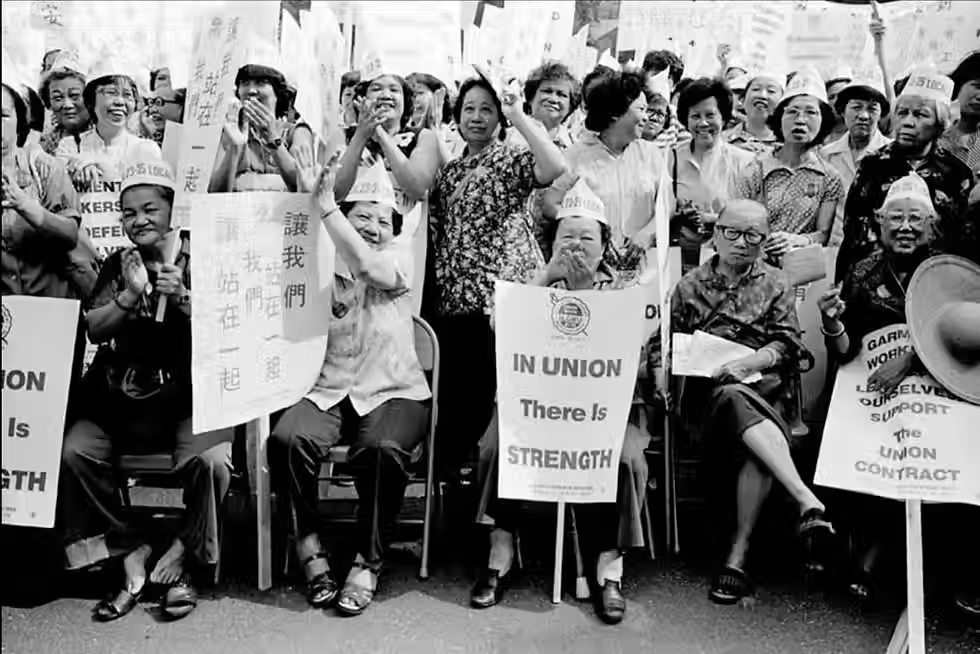
The garment workers in Chinatown were paid piecework rates; this meant that they were paid per garment they made, no matter how long it takes to sew (Chan). For example, the worker earned 50 cents for making either a skirt or jacket (Serrin). Besides the little pay, these women worked in crowded spaces with poor airflow for more than 10-hour workdays (Chang). It wasn’t until 1982 when employers tried to cut union benefits by reducing health insurance and days off that the workers decided to go on strike. On June 24th and July 15th, about 20,000 Asian garment workers marched as they carried signs reading “In union, there is strength,” and “Support the union contract” (Chang). This strike was both the largest in Chinatown history and one of the largest strikes in the garment industry history (“40 Years Later, Labor Leaders Remember NYC Chinatown's Garment Worker Strike”). Within hours, the strike ended in a success with the workers keeping their union benefits (Chan).
EFFECTS ON THE INDUSTRY
New York City as a whole remained the leader in garment production until the September 11th terrorist attacks in 2001; this caused the garment industry in Chinatown to decline. Chinatown is less than a mile away from the World Trade Center, so after the attacks, the town had no phone service for months (“Q&A: Margaret M. Chin on the New York City Garment Industry”). Additionally, most of the shops were not within the area funded by the early Federal Emergency Management Agency (FEMA), an agency that provides relief for emergencies and disasters through grants. And with several roads closed, materials needed for the garments were unable to be transported by the trucks to the factories (Swanson).
Just three months after the attacks, 40 garment factories in Chinatown were closed, and a year later, the number of closures increased to 65; this cost the industry about $500 million in revenue (Asian American Federation of New York). Because of this, most garment production became overseas.
A SUCCESS STORY
One of Chinatown’s garment factories in particular was located on 148 Lafayette Street, owned by Shun Yen Siu. Siu had immigrated to the United States in the late 1960s to work as a garment worker (Chao). By the 1970s, he owned several factories with some even manufacturing clothes for designer brands like Burberry. In the 1990s, with an excess of fabric, he decided to produce a collection of jackets and sell them at a price of $100 for three; the collection quickly sold out. In 1996, he, his wife Ida Siu, and Deidre Quinn decided to transform the Lafayette factory into a fashion brand called Lafayette 148 (Chao).

Though the September 11th attacks caused numerous garment factory shutdowns in Chinatown, Lafayette 148 remained a success. While much of the industry shifted to overseas markets because of the catastrophe, Siu adapted to this shift by hiring Chinese artisans in Shantou, China to work alongside his New York team (Chao).
Today, the Lafayette 148 manufactures and designs clothes, and also produces custom orders for 400 stores across the United States, including Saks Fifth Avenue. Siu can now sell a singular jacket for a price of $600, instead of three for $100 (Chao).

TODAY
The garment industry in Chinatown is no longer the same as it used to be, especially after the COVID-19 pandemic. Nowadays, mostly just specialty sewers — those who make costumes or high-end clothing — remain in Chinatown (“Q&A: Margaret M. Chin on the New York City Garment Industry”). Nonetheless, Chinatown’s garment industry will always be a significant part of New York City’s fashion history.
“40 Years Later, Labor Leaders Remember NYC Chinatown's Garment Worker Strike.” NBCNews.com, NBC Universal News Group, 15 May 2022, https://www.nbcnews.com/news/asian-america/40-years-later-labor-leaders-remember-nyc-chinatowns-garment-worker-st-rcna25469.
Asian American Federation of New York, 2002, Chinatown One Year After September 11th: An Economic Impact Study, https://www.aafederation.org/wp-content/uploads/2019/08/ChinatownOneYearAfter911.pdf.
Chan, Huiying. “How Chinese American Women Changed U.S. Labor History.” Asian American Writers' Workshop, 1 May 2019, https://aaww.org/chinatown-garment-strike-1982/.
Chang, Rachel. “When 20,000 Asian Americans Demanded Garment Workers' Rights-and Won.” History.com, A&E Television Networks, 30 Apr. 2021, https://www.history.com/news/garment-workers-strike-chinatown.
Chao, Eveline. “A Makeover for Chinatown's Garment Industry.” Asian American Writers' Workshop, 17 Aug. 2016, https://aaww.org/makeover-for-chinatowns-garment-industry/.
Chin, Margaret May. Sewing Women: Immigrants and the New York City Garment Industry. Columbia University, 2005.
“FEMA Grants.” FEMA.gov, https://www.fema.gov/grants.
“Immigration and Nationality Act of 1965.” US House of Representatives: History, Art & Archives, https://history.house.gov/Historical-Highlights/1951-2000/Immigration-and-Nationality-Act-of-1965/.
“The Kheel Center Ilgwu Collection.” ILGWU Web Site - Home, http://ilgwu.ilr.cornell.edu/.
“Museum of Chinese in America.” 1982 Garment Workers Rally and Strike in Chinatown – Museum of Chinese in America, https://www.mocanyc.org/2022/03/08/1982-garment-workers-rally-and-strike-in-chinatown/.
“Q&A: Margaret M. Chin on the New York City Garment Industry.” Columbia University Press Blog - Publishing a Universe of Knowledge for Readers Worldwide, 19 May 2020, https://cupblog.org/2020/05/19/qa-margaret-m-chin-on-the-new-york-city-garment-industry/.
Serrin, William. “After Years of Decline, Sweatshops Are Back.” The New York Times, The New York Times, 12 Oct. 1983, https://www.nytimes.com/1983/10/12/nyregion/after-years-of-decline-sweatshops-are-back.html.
Soyer, Daniel. A Coat of Many Colors Immigration, Globalization, and Reform in New York City's Garment Industry. Fordham University Press, 2005.
“Stitching the Seams between Past & Present: A Conversation with a Modern NYC Garment Shop.” Tenement Museum, 23 Aug. 2017, https://www.tenement.org/blog/stitching-the-seams-between-past-present-a-conversation-with-a-modern-nyc-garment-shop/.
Swanson, Stevenson. “N.Y.'s Chinatown Tries to Bounce Back from 9/11, Sars.” The Washington Post, WP Company, 15 Aug. 2004, https://www.washingtonpost.com/archive/politics/2004/08/15/nys-chinatown-tries-to-bounce-back-from-911-sars/bcd7970d-3d43-4e03-8b48-924d413aaa09/.
“History of American Sweatshops: 1940-1997.” National Museum of American History, 11 Apr. 2019, https://americanhistory.si.edu/sweatshops/history-1940-1997.
Tenement Museum. “Stitching the Seams between Past & Present: A Conversation with a Modern NYC Garment Shop.” Tenement Museum, 23 Aug. 2017, https://www.tenement.org/blog/stitching-the-seams-between-past-present-a-conversation-with-a-modern-nyc-garment-shop/.
Waldinger, Roger. “Immigrants Rescue The Rag Trade.” Immigrants Rescue the Rag Trade | City Journal, 1991, https://www.city-journal.org/html/immigrants-rescue-rag-trade-12773.html.